
Published by Giovanni Patania
on 09/13/2026
If a tenant leaves your HMO and you’re staring at a stained carpet or a broken worktop with no way to prove it wasn’t like that when they arrived, you already know how this goes. Without solid evidence, “reasonable wear and tear” usually wins the argument, and the deposit deduction you were counting on disappears. At HMO Architects™, we see this most often not because landlords skip the inventory, but because they only do half of one, covering the bedroom and forgetting the parts of the house every tenant actually shares.
This guide covers what a proper HMO inventory needs to include, how to record it so it holds up if challenged, and how to time it correctly. If you’d rather talk through your specific set-up, book a free call and we’ll help you work out what your property needs.
Why an HMO Inventory Has to Cover More Than the Bedroom
A single-let inventory is straightforward: one tenant, one set of rooms, one condition report. An HMO is different because several tenants share responsibility for the same kitchen, bathrooms, hallways, and often a garden or bike store. If your inventory only documents private rooms, you have no baseline for the areas most likely to show damage: burnt worktops, missing crockery, damaged communal furniture, or a garden nobody claims responsibility for.
A move-in inventory that only covers the bedroom protects you for one-fifth of the property. When a dispute reaches adjudication, the areas without a documented starting condition are the ones you can’t defend, and they’re usually where the highest-value damage happens.
What to Record in Each Tenant’s Room
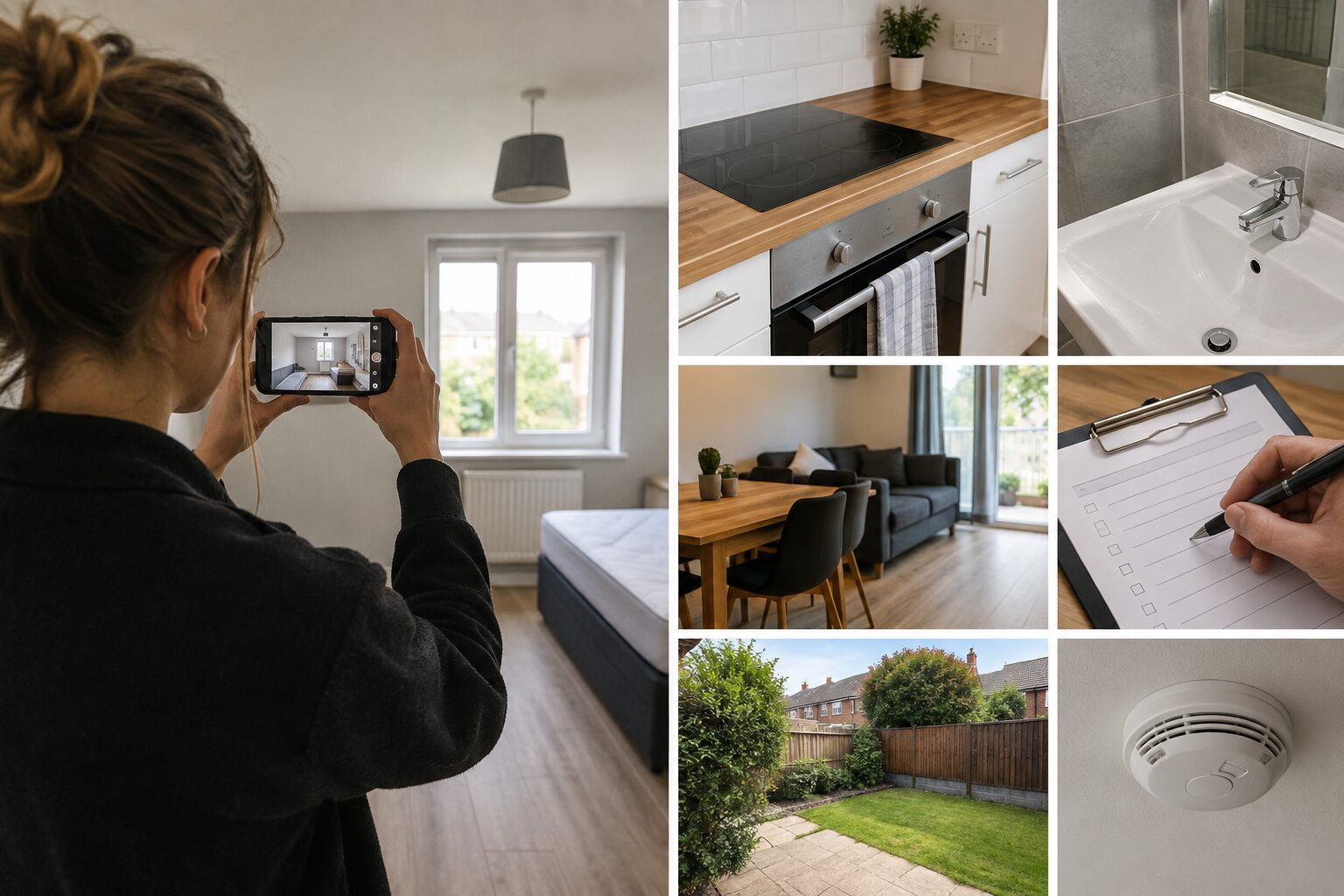
For every room, work through the same sequence each time so nothing gets missed and no tenant gets a different standard of check than another:
- Wide shots of all four walls, the ceiling, and the floor, followed by close-ups of anything with existing wear, marks, or damage
- Condition notes on walls, carpet or flooring, curtains or blinds, and any furniture provided (bed frame, mattress, wardrobe, desk)
- Working condition of fixtures: light fittings, sockets, window locks, radiator, smoke alarm
- Meter readings where the room has its own metered supply, or a note confirming it doesn’t
Date-stamp every photo and keep the file names consistent with the room number, so you’re not trying to reconstruct which photo belongs to which tenant six months later when a dispute lands.
What to Record in the Shared and Common Areas
This is the section most HMO inventories skip, and it’s the one that causes the most disputes. Walk the kitchen, bathrooms, hallways, stairs, and any garden or outdoor storage exactly as you would a bedroom: photograph the appliances individually (oven, fridge, washing machine), note their condition and approximate age, record any existing damage to worktops or units, and check smoke and heat alarms in shared circulation spaces.
Communal furniture needs the same treatment as private-room furniture: a sofa, dining table, or shared wardrobe should be photographed and described on day one, not left as an assumption. If the property has a shared garden, photograph it too. Garden condition disputes are common precisely because nobody thought to record what it looked like before anyone moved in.
Get the Timing Right: Before Move-In, Not After
The inventory has to happen before the keys change hands, ideally on the same day as check-in but before the tenant has occupied the room. An inventory taken after the keys change hands is not evidence. It is a guess with a signature, because by the time you’re photographing a room a tenant has already been living in, you can no longer separate what was there before from what happened in the first week.
Where possible, walk the property with the tenant present, or send the completed inventory for them to review and confirm within a short window (48 hours is common practice) if a joint walk-through isn’t feasible with several tenants moving in on different days. A tenant who has had the chance to flag something and didn’t is a much stronger position for you than one who never saw the document at all.
Where HMO Landlords Lose Inventory Disputes
The pitfalls that come up again and again aren’t complicated, but they’re easy to miss under time pressure:
Photos with no date or timestamp are hard to defend, because there’s no way to prove they were taken at check-in rather than pulled from an old listing. Generic descriptions like “kitchen in good condition” carry far less weight than specific ones (“worktop has an existing 4cm scorch mark near the hob, kitchen units otherwise unmarked”), because adjudicators weigh specificity heavily when deciding what counts as pre-existing. And inventories stored only on a phone, with no backup, have a habit of disappearing exactly when you need them, usually eighteen months into a tenancy when the phone in question has been replaced twice.
Adjudicators do not reward good intentions. They reward evidence with a date on it, filed somewhere you can actually retrieve it.
Connecting the Inventory to Your Deposit Protection Evidence
Under the Housing Act 2004, any deposit taken for an assured shorthold tenancy in England must be placed in a government-approved scheme (the Deposit Protection Service, mydeposits, or the Tenancy Deposit Scheme) within 30 days of receipt, and the tenant must be given the scheme’s prescribed information in the same window. Your inventory sits alongside that process rather than inside it: the scheme protects the money, but it doesn’t decide whether a deduction is fair. That’s what the inventory is for.
If a dispute reaches the scheme’s free adjudication service, the adjudicator will weigh your check-in inventory against your check-out report and decide what falls under fair wear and tear versus genuine damage. An inventory with no dated photos, no room-by-room detail, or no tenant sign-off gives the adjudicator very little to work with, and disputes without strong evidence are typically resolved in the tenant’s favour by default. Keeping the inventory, the prescribed information confirmation, and any subsequent correspondence together in one place (rather than scattered across email and phone storage) makes this process considerably less stressful if a claim ever does arise. This is where a system like COHO can help, since it gives you one place to store inventories and compliance records against each tenancy rather than relying on a folder of old emails.
Using the Same Inventory at Check-Out
Your move-in inventory isn’t a one-off task. Reuse the exact same document, room by room, at check-out, comparing current condition against the original entry line by line. This is where the detail you put in at the start pays off: “worktop has an existing 4cm scorch mark” means you can immediately see whether new damage has appeared, rather than trying to remember from memory whether that mark was always there.
If the comparison shows genuine damage beyond fair wear and tear, you have the two dated records needed to justify a deduction. If it doesn’t, you avoid a dispute you’d have lost anyway.
Is Your Move-In Inventory Dispute-Ready?
If you answer “no” to any of these, fix it before your next tenant moves in:
- Does the inventory cover the kitchen, bathrooms, and hallways, not just the bedroom?
- Is every photo dated or timestamped?
- Does each room have specific condition notes, not general ones?
- Was the inventory completed before the tenant occupied the room?
- Is it stored somewhere you can retrieve it in eighteen months, not just on a phone?
What to Do Next
A thorough inventory takes an extra hour at check-in. A weak one costs you the deposit deduction you were relying on, and often the goodwill of a tenant who feels unfairly accused. If cost or time is the thing holding you back, the honest answer is that this is one of the cheapest pieces of HMO paperwork you’ll ever do relative to what it protects.
Pair your inventory with clear house rules so tenants know what’s expected of them from day one, and if you’re actively filling rooms, our guide to finding new HMO tenants covers the referencing and paperwork sequence that sits alongside check-in. If your wider maintenance system feels reactive rather than planned, our PPM maintenance checklist guide is a natural next step.
If you want a second pair of eyes on your HMO’s management systems more broadly, book a free call with HMO Architects™. We’ll talk through your current set-up, flag any gaps, and agree the most useful next steps for your property. For ongoing tips on managing and growing an HMO portfolio, you can also sign up to the HMO Masters newsletter.
FAQs
Is an HMO inventory a legal requirement?
There’s no single law that mandates a written inventory. In practice, it functions as your main defence if a deposit dispute goes to adjudication, so treat it as essential even though it isn’t a licensing condition.
Do I need a separate inventory for each tenant’s room?
Yes. Each room needs its own dated condition record, since tenants move in and out on different dates and each one needs a fair, individual baseline.
How long should I keep the inventory after check-out?
Keep it for at least the length of the tenancy plus the time it takes to resolve any post-tenancy dispute, in practice a year is a sensible minimum, longer if the deposit claim is contested.
What counts as fair wear and tear versus damage?
Adjudicators generally treat gradual deterioration from normal living (light carpet wear, faded paint) as wear and tear, while damage like burns, stains beyond normal use, or breakages is assessed against your inventory’s original condition notes. Verify the specific position with your deposit scheme if a claim is contested, since adjudicators weigh each case on its evidence.
Published by Giovanni Patania
on 09/13/2026
Giovanni is a highly accomplished architect hailing from Siena, Italy. With an impressive career spanning multiple countries, he has gained extensive experience as a Lead Architect at Foster + Partners, where he worked on a number of iconic Apple stores, including the prestigious Champs-Élysées flagship Apple store in Paris. As the co-founder and principal architect of WindsorPatania Architects, Giovanni has leveraged his extensive experience to spearhead a range of innovative projects.