
Published by Giovanni Patania
on 04/27/2026
A building can start to look like a co-living opportunity surprisingly quickly.
You see the location, the likely tenant profile, the chance to create better communal space, and the possibility of charging more than a standard shared house. That is usually the point where the idea starts to gather momentum. It is also the point where the route can drift if the concept is running ahead of the building, the planning position, or the management model.
That is the real issue here. Not simply the co-living meaning in theory, but whether this property can genuinely support a stronger shared-living offer without you overpromising, overspecifying, or pushing into the wrong planning route.
There is a calmer way to test that. If you want an early view on whether your building suits a co-living approach, you can book a free call. We will help you to understand the property, the shared-living model you are considering, where the design or planning pressure is likely to sit, and which checks should come next before the concept hardens.
Keep reading and you will have a much clearer sense of what co-living accommodation actually means, where it still overlaps with HMO territory, and when the idea is worth pushing further.
What is a co living space, and why it is not just a nicer HMO
A co-living space is usually a shared-living scheme designed around a more deliberate resident offer.
That can mean better communal areas, a clearer resident offer, stronger design, and a tenant profile that is being targeted more carefully than in a basic shared house. In practice, that is usually the kind of offer people have in mind when they talk about co-living.
A co-living idea only works when the layout, amenity offer, management standards, and likely tenant demand all support the promise being made. If those points do not line up, the scheme can end up feeling like an expensive HMO rather than a stronger shared-living product.
Co-living meaning in practical terms
In practical terms, co-living usually means shared accommodation with more intention behind it.
You are not only providing bedrooms and shared facilities. You are shaping how people live in the building, how communal areas work, what standard the shared spaces need to reach, and what kind of resident experience the scheme is meant to deliver.
That does not automatically make it a different legal category. It does mean the project should be tested as a different offer.
What still makes a property an HMO, and what changes when the offer shifts
An HMO has a legal housing meaning. Co-living is often used more loosely. So if you blur the two, the whole route can start to sound simpler than it really is.
A building can still be an HMO in legal and operational terms while being designed and positioned in a more premium, design-led way. That is one reason the comparison between HMO and co-living is not just about style. It is about what the building is, how it is used, and what standards the concept can really sustain. If you need grounding on the legal route, start with the small HMO rules.
Why the legal answer and the design answer are not the same
A scheme can have better shared space, stronger branding, and a more premium tenant offer without automatically moving out of HMO territory.
You may be improving the design answer while the legal answer stays broadly the same. Equally, once a project becomes larger, more purpose-built, or more operationally ambitious, the planning answer may start to change even if the shared-living idea still sounds familiar.
So before you decide that the building is “co-living”, start by asking what it is already, what approvals it needs, and whether the proposed offer changes the route in any meaningful way.
Why some shared-living schemes feel premium and others just feel crowded
This is usually the part that decides whether the idea has real depth.
Two schemes can both talk about shared living and still perform very differently in practice. One feels bright, well planned, and socially usable. The other feels tighter than expected, under-amenitised, and more expensive than the experience justifies.
The difference is rarely the label alone.
Large-scale co-living developers understand this well. The stronger schemes are not just groups of bedrooms with a shared kitchen. They often create a fuller lifestyle offer, with commercial or amenity space on the ground floor, such as a coffee shop, gym, yoga studio, workspace, or managed communal lounge. Not every HMO or smaller co-living project can offer that scale, but the lesson still applies: the shared spaces need a clear purpose.
Layout, communal space, and resident experience
If you want co-living to feel credible, the shared areas have to do real work.
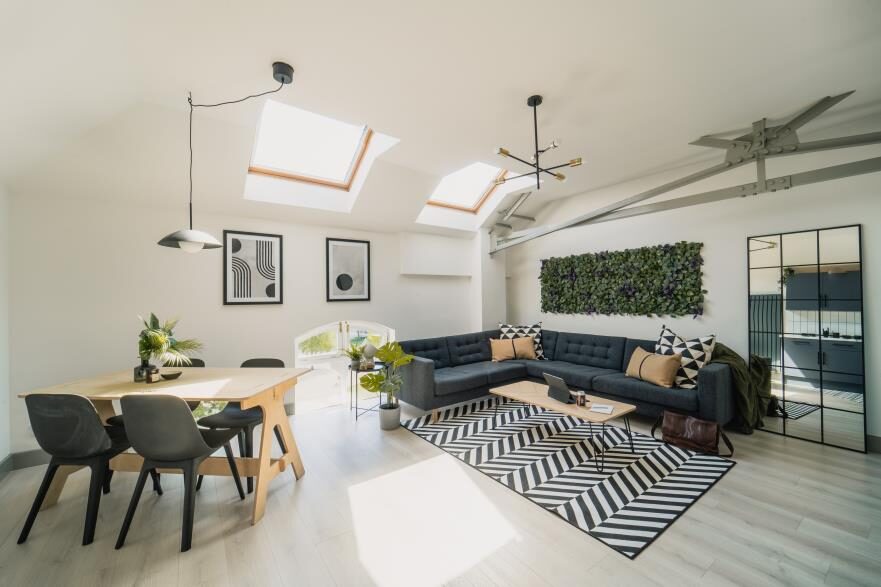
In our co-living schemes, we often talk about creating a catalyst for interaction. In most houses, that catalyst is the kitchen, dining, and living area. The design question is not just “is there enough communal space?” It is “what will actually get people out of their rooms?”
That becomes especially important when the bedrooms are large. One of our early co-living projects was the conversion of a former nightclub into a 12-person co-living scheme. The bedrooms alone were over 20+ sqm, so the risk was clear. If every resident had enough space to retreat completely, the shared areas had to offer a strong reason to come together.
That is where demographic research, infrastructure investment in the area, property design, and good management all start to connect. You need to understand who the scheme is for, what kind of lifestyle they are likely to value, and how the building can support that. A generous kitchen-diner, comfortable living space, good lighting, storage, acoustics, and well-planned circulation all help the property feel social without forcing interaction.
That means enough usable communal space, sensible circulation, rooms that feel liveable rather than just compliant, and a layout that supports privacy and interaction in the right balance. Natural light, sound separation, storage, and the quality of kitchens and bathrooms matter more here than many landlords first expect.
This is why design carries more weight in co-living than in a basic HMO. You are asking the building to justify a stronger lifestyle offer, not just a place to sleep.
If you want a useful design-led companion read at this point, this guide on why your shared living space needs an interior designer is a strong next step.

Management intensity and day-to-day standards
A co-living scheme usually needs stronger day-to-day management than a basic shared house. That may include cleaner standards, tighter maintenance response, clearer house rules, stronger tenant selection, better onboarding, and a more active approach to how shared spaces are looked after.
That matters because the resident experience is not created once at fit-out stage and then left alone. It has to be maintained. That is also why it helps to understand how to set up an HMO properly before you assume the operating model will take care of itself.
If that management burden does not fit your intended operating model, the scheme may be better treated as a well-designed HMO instead of a fuller co-living offer.
When co-living adds value, and when an HMO is enough
Not every shared-living project should be pushed into a co-living label.
Sometimes the building, the location, and the tenant market genuinely support that move. Sometimes the better answer is to deliver an excellent HMO without promising more than the scheme can sustain.
A real co-living route usually needs stronger design quality, better communal amenity, more deliberate resident positioning, and management standards that can carry the concept after completion.
A high-quality HMO may still be the better answer where the building is smaller, the planning route is tighter, the market is more price-sensitive, or the budget is better spent on good fundamentals than on a premium lifestyle pitch. If that is the comparison you are making, it helps to step back and ask is HMO still worth it.

What the local planning position may change
On some schemes, especially larger or more purpose-built shared-living proposals, local planning policy can change the answer significantly. That is often the point where Sui Generis planning starts to matter more. That is particularly important in places where shared-living or purpose-built shared-living has its own guidance, or where the council takes a close view on amenity, management, and the justification for the use.
So if the concept is moving beyond a smaller design-led HMO and towards something more operationally ambitious, verify the local planning position before you build too much around the co-living idea.
A project example that shows the difference in practice
A useful example here is Fletcher Street.
It is relevant because this was not treated as a basic room-led HMO. The scheme repositioned a former nightclub into a bright, high-quality co-living HMO for professionals, with a much stronger emphasis on resident experience than you would expect from a standard shared house.
That makes it a good proof point for this page. It shows the space where co-living and HMO still overlap in legal and operational terms, but where the design approach, tenant positioning, and shared-living quality are doing something more deliberate.
The lesson is not that every HMO should be called co-living. It is that some buildings can support a stronger shared-living proposition when the layout, management model, and target market all line up properly.
What to check before you call a scheme co-living
The safest route is to test the concept in order.
Start with what the property is now in planning and operational terms.
Then test whether the target tenant and the likely rent level genuinely support a more premium shared-living offer.
After that, look closely at layout, communal amenity, room quality, bathrooms, kitchens, storage, lighting, and the flow of the building.
Then check whether the management model is strong enough to support the standard you are promising.
Only after that should you decide whether co-living is the right language and the right route.
If the design concept itself still needs shaping, the architectural design service is the most relevant place to start. If the real pressure sits more in how the interiors, communal spaces, and resident experience need to work together, the interior design service becomes especially useful.
Need a second view on whether your building suits co-living?
If the building still looks promising but the route feels less obvious now that the design, management, and planning questions are clearer, that is a good point to pause and test it properly.
You can book a free call if you want to talk through the property, the shared-living model you are considering, the likely planning or design pressure points, whether HMO Architects can help shape the route, and which checks should come before you invest further.
If you want occasional guidance on topics like this as the market keeps shifting, you can also join the newsletter.
FAQs
What is a co living space in simple terms?
A co-living space is a shared-living scheme that usually offers a stronger sense of design, communal amenity, and resident experience than a basic shared house.
Is co-living legally different from an HMO?
Not always. A scheme can still fall within HMO territory while being positioned more like co-living. The legal and planning route needs checking separately from the design concept.
What is co living accommodation usually trying to offer?
Usually a more deliberate shared-living experience, often aimed at professionals who want better communal areas, stronger design, and a higher standard of day-to-day living.
Can a normal HMO be upgraded into co-living?
Sometimes yes, but only if the building, layout, tenant demand, and management model can genuinely support the uplift in offer.
Does co-living need planning permission?
That depends on what the property is now, what changes are proposed, and what local planning policy says. It should never be assumed from the label alone.
When is a high-quality HMO better than calling it co-living?
Usually when the building works well as shared accommodation but does not have the scale, amenity, budget, or market to support a fuller co-living proposition.
What makes co-living work financially?
It usually needs the right tenant market, rent levels that justify the extra investment, strong design, and management standards that protect the resident experience after the building is occupied.
Published by Giovanni Patania
on 04/27/2026
Giovanni is a highly accomplished architect hailing from Siena, Italy. With an impressive career spanning multiple countries, he has gained extensive experience as a Lead Architect at Foster + Partners, where he worked on a number of iconic Apple stores, including the prestigious Champs-Élysées flagship Apple store in Paris. As the co-founder and principal architect of WindsorPatania Architects, Giovanni has leveraged his extensive experience to spearhead a range of innovative projects.