
Published by Giovanni Patania
on 09/10/2026
If you’re preparing an HMO licence application, responding to a council query, or a tenant has just asked why their room has no carbon monoxide alarm, this is the page to read before you buy another alarm. Smoke and carbon monoxide alarm rules sit at the front of every HMO licensing inspection, and getting the grade wrong is one of the more common reasons a licence gets delayed rather than granted. At HMO Architects™, we’ve specified fire detection on HMO conversions from single-let refurbishments to a 24-bedroom former police station, so we see this go wrong from both the design side and the investment side. If your project needs a proper review before it goes in front of a licensing officer, book a free call and we’ll walk through what your property actually needs.
What the law requires for every rented property
Every private rented property in England, including HMOs, is covered by the Smoke and Carbon Monoxide Alarm (England) Regulations 2015, updated by the 2022 amendment. The baseline duty is short: fit at least one smoke alarm on every storey used as living accommodation, fit a carbon monoxide alarm in any room used as living accommodation that contains a fixed combustion appliance other than a gas cooker, and check both are working at the start of every tenancy. Since October 2022, you also have a clear legal duty to repair or replace a faulty alarm as soon as reasonably practicable once a tenant tells you about it, including replacing the battery.
This national baseline applies whether you own a single buy-to-let or a licensed HMO. But it’s written for a standard single household, not a house with five unconnected tenants sharing escape routes, kitchens, and fire risk. That’s the gap that catches out a lot of first-time HMO landlords: they treat the 2015/2022 Regulations as the finish line, when for a licensable HMO they’re really the starting point.
Why HMOs usually need more than the legal minimum
Licensable HMOs are technically exempt from Parts 1 to 5 of the Smoke and Carbon Monoxide Alarm Regulations, but only because the Housing Act 2004 licensing regime already imposes an equivalent, and usually stricter, standard through your licence conditions. In practice, this means the smoke alarm detector network your council will accept is set by BS 5839-6, not by the smoke alarm rules a single-let landlord relies on.
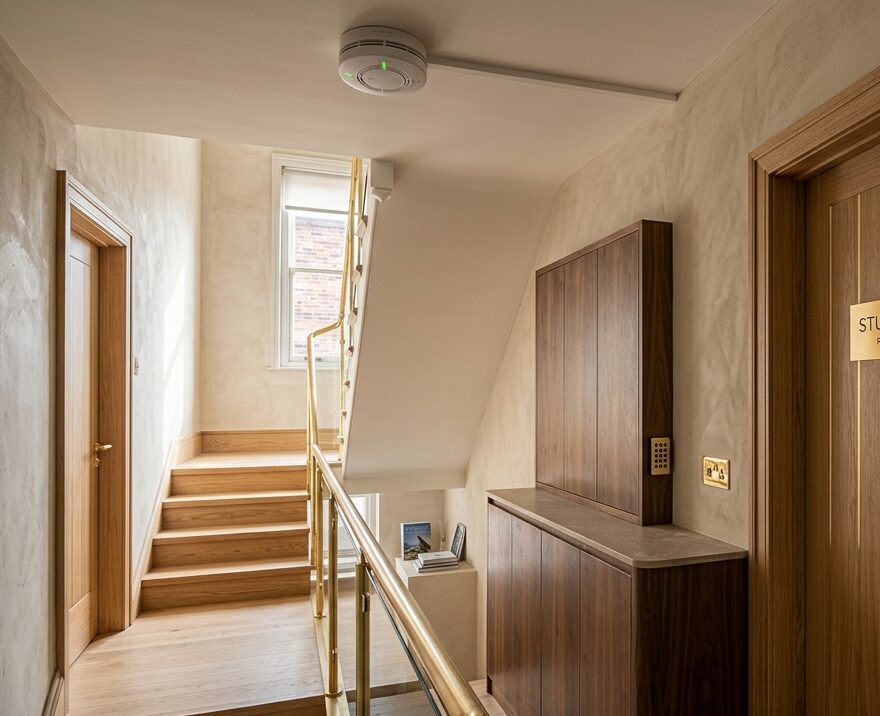
BS 5839-6 grades the system by build quality and categorises it by coverage. A small, low-risk shared house might get away with Grade D, Category LD2: mains-powered, interlinked alarms with battery backup, covering the escape route and higher-risk rooms like the kitchen. Larger HMOs, bedsit-style properties, and anything over three storeys usually need Grade A, Category LD1: a proper panel-controlled system with detection in every let room, not just the corridors. Battery-only smoke alarms, Grade F, are rarely acceptable for a licensable HMO at all, because they don’t interlink reliably across a shared building. If one detector goes off in a bedroom on the top floor, everyone on every floor needs to hear it, not just the tenant in that room.
This is where the HMO Compliance Risk Stack™ earns its place. Rather than asking “have I fitted an alarm,” ask where the real exposure sits: your licensing position (does the grade specified in your licence conditions match what’s actually installed), your operational reality (is the system still interlinked, or has a replaced unit broken the chain), your timeline exposure (is your service certificate still in date), and your evidence (can you produce a logbook if challenged). Most licence refusals on fire detection don’t happen because nobody fitted an alarm. They happen because the wrong grade went in, or the right grade was fitted and then quietly degraded through a mismatched replacement part.
Our largest fire detection specification to date was on a 24-bedroom conversion of a former police station in Anfield, where the scale of the building meant a Grade A system with detection in every guest room was never optional. Most HMO landlords aren’t converting a police station, but the same logic scales down: the bigger and more sectionalized the property, the less room there is to treat alarm specification as an afterthought.
Carbon monoxide alarms: where they’re compulsory
The carbon monoxide alarm rule is narrower than most landlords assume, and that’s exactly where mistakes happen. A carbon monoxide detector is a legal requirement in any room used as living accommodation that contains a fixed combustion appliance other than a gas cooker. That covers a room with a gas fire, a gas or oil-fired boiler, or a solid fuel stove. It does not, on its own, require a carbon monoxide alarm in every bedroom of an HMO, only in the rooms where a qualifying appliance actually sits.
The practical trap in HMOs is boiler cupboards and shared plant rooms. If a combi boiler serving the whole property sits in a cupboard off a communal hallway, that space still counts as a room with a fixed combustion appliance, and it needs its own carbon monoxide alarm, even though nobody sleeps there. Landlords who only think about carbon monoxide alarm placement bedroom by bedroom tend to miss this, then get picked up on it at inspection. Verify the exact list of qualifying appliances and current guidance for your property directly against the government’s explanatory booklet, since council interpretation of edge cases like log burners in communal lounges can vary.
Testing, records, and where landlords get caught out
A working alarm on the day of installation tells an inspector very little. What actually protects you, and your tenants, is a testing and record-keeping routine you can produce on demand. For a Grade D system, weekly push-button testing is best practice, alongside routine checks at every inspection or cleaning visit. For a Grade A panel system, most licences require a six-monthly service by a competent alarm engineer, with an Inspection and Servicing Certificate issued to BS 5839-1, and weekly checks logged in between.
The pattern we see most often on HMO portfolios spread across multiple councils is a working alarm system with no paper trail behind it. The alarms are fine. The logbook doesn’t exist, or stops three months before the inspection. A council officer can’t verify a system that works today was also working, tested, and maintained last quarter, and an absent record is treated the same as a failed test. If keeping that logbook consistent across several properties is the actual bottleneck, COHO’s compliance tracking is worth a look, since it’s built to hold exactly this kind of dated testing and maintenance record in one place rather than in a drawer of paper certificates.
Common mistakes we see on real projects
The single most expensive mistake is specifying fire detection after the layout is fixed, rather than during design. This is where the HMO Architects Dual-Lens Approach™ actually changes the outcome: designing as architects and investing as landlords means we’re placing detection, cable routes, and interlink zones at the same stage we’re deciding room layouts and bedroom count, not retrofitting a panel system into a finished conversion because the licensing officer flagged it late. A Grade A upgrade fitted after completion typically means chasing walls that are already decorated, which costs far more than the same spec designed in from the start.
The second recurring mistake is heat detectors, not smoke detectors, missing from kitchens. A smoke alarm in a kitchen produces enough nuisance alarms from cooking that tenants disconnect it within weeks, which then breaks the interlink for the whole building. Kitchens need a heat detector, interlinked with the rest of the system, precisely because smoke detection there causes more problems than it solves.
Should you proceed to your next licence submission on your current alarm setup? If you can’t answer yes to all of these, stop and check before you submit:
- Does the fitted grade and category match what your licence conditions actually specify, not just what a previous owner installed?
- Is every alarm still genuinely interlinked, including after any recent replacements?
- Do you have a current, in-date service certificate for the system as installed?
- Can you produce a weekly test log covering the period since the last inspection?
What to do next
Smoke and carbon monoxide alarm compliance rarely sits on its own. It usually connects to fire doors, escape route lighting, and the wider fire risk assessment for the building, so it’s worth reviewing alongside our guide to HMO fire regulations and requirements and our breakdown of HMO fire door requirements, since a Grade A alarm system won’t save a licence application if the doors on the same escape route aren’t rated correctly. If you’d rather build alarm testing into a wider maintenance routine instead of chasing it property by property, our planned preventative maintenance guide sets out how to fold it into a schedule you actually keep up with. If you’re still building out your general landlord compliance habits beyond HMO-specific rules, Rob Dix’s, How to Be a Landlord is a solid grounding in the practical side of running rental property day to day.
Cost and disruption are the two things that usually stop landlords acting on this early. A full re-spec doesn’t have to mean ripping out a working system: in most cases it means an assessment against your current licence conditions, then a targeted upgrade of the parts that don’t match, not a wholesale replacement. Book a free call and tell us about the property; we’ll help you work out what your current setup actually needs, what’s already compliant, and the most useful next step, whether that’s a design review, a compliance check, or simply confirming you’re already covered. For practical updates on HMO compliance as standards shift, it’s also worth joining the HMO Masters newsletter.
FAQs
Do all HMO bedrooms need a smoke alarm?
Not necessarily. A Grade D, Category LD2 system covers escape routes and high-risk rooms, not every bedroom. Larger and higher-risk HMOs are increasingly required to fit Category LD1, which does put detection in every room, including bedrooms. Check your specific licence conditions rather than assuming either standard applies.
Does a gas cooker need a carbon monoxide alarm nearby?
No. Gas cookers are specifically excluded from the fixed combustion appliance rule. The requirement applies to gas fires, gas and oil boilers, and solid fuel appliances, not cooking appliances.
Can I use battery-only smoke alarms in an HMO?
Almost never for a licensable HMO. Councils generally expect mains-powered, interlinked alarms with battery backup as a minimum, and larger or higher-risk properties usually need a full panel system. Battery-only Grade F alarms are typically reserved for the lowest-risk, smallest shared properties, and only where a council schedule explicitly allows it.
Who is responsible for testing alarms in an HMO, the landlord or the tenant?
The landlord holds the legal duty to install the correct system, maintain it, and keep records of testing and servicing. Tenants are often asked to carry out simple weekly button tests as part of the household routine, but that doesn’t transfer the underlying compliance duty away from the landlord.
What happens if an alarm fails an inspection?
The council can serve a remedial notice requiring the fault to be fixed, usually within 28 days. Ignoring it can lead to the council carrying out the work and recovering the cost, plus a financial penalty, and it’s an aggravating factor in any prosecution following a fire or carbon monoxide incident at the property.
Published by Giovanni Patania
on 09/10/2026
Giovanni is a highly accomplished architect hailing from Siena, Italy. With an impressive career spanning multiple countries, he has gained extensive experience as a Lead Architect at Foster + Partners, where he worked on a number of iconic Apple stores, including the prestigious Champs-Élysées flagship Apple store in Paris. As the co-founder and principal architect of WindsorPatania Architects, Giovanni has leveraged his extensive experience to spearhead a range of innovative projects.