

Published by Giovanni Patania
on 06/05/2026
If you are buying, converting, refinancing, or fixing up an HMO, fire compliance can become the point where a simple plan starts to wobble. On paper, the property may look workable. In reality, the fire setup can affect layout, licence compliance, Building Regulations, cost, and whether the scheme is worth pushing forward at all.
That pressure is real. A lot of landlords and investors are not trying to dodge fire rules. They are trying to work out which rules actually apply to this building, and which bits of online advice are too generic to trust. We also often speak to clients who have already taken a scheme through planning with a non-specialist architect. Others have been told not to worry because the route is permitted development. The problem often only appears later, when the project reaches Building Regulations stage and the design starts to come under pressure. By that point, issues such as fire-protecting walls, fire boarding, and escape travel distances may not have been properly allowed for from the start.
You do not need to guess your way through it. This guide will help you understand what fire duties apply, what depends on the building and local authority, and what to check before spending money. These points should be tested before planning is treated as settled, whether the route is full planning or permitted development. If you need a second view on a live HMO project, you can book a free call to clarify the main risks and next steps.
Keep reading and you will have a much clearer view of what to check first, where the real risks sit, and when you need project-specific advice.
The fire rules depend on your building, not just the word “HMO”
The first mistake is treating HMO fire regulations as one fixed checklist.
Two properties can both be HMOs and still need different fire measures because the risk profile is different. Storey count matters. Height matters. The way the building is laid out matters. Shared escape routes matter. So does the difference between an existing rented house, a new conversion, a flat-based scheme, or a mixed-use building.
That is why the answer is rarely as simple as “every HMO needs this alarm system” or “every HMO needs that door.” Some duties apply widely across relevant buildings in England. Other requirements come from the fire risk assessment, local HMO licensing standards, or the practical reality of the layout. The tenant profile can also affect the risk picture, especially where the property is housing more vulnerable occupiers or sits within a more specialised management or care setting.
Why landlords get caught out
You might read that HMOs need a certain fire alarm grade, a certain type of fire door, emergency lighting, or a protected route, and assume that settles it. Then the council, fire risk assessor or Building Control officer reads the building differently. At that point, what looked like a tidy compliance plan turns into redesign, re-specification, delay, or extra cost.
This is why it helps to separate the issues clearly:
- Fire safety law deals with duties around fire precautions and management.
- HMO licensing can add local standards and conditions.
- Building Regulations come into play when you are converting, altering or regularising works.
- Layout and management affect how the strategy works in practice.
If you keep those strands separate, it becomes much easier to see what needs checking first.
Which fire duties apply to most HMOs in England
For most HMOs in England, there is a national baseline, but it only gets you to the starting line.
The common parts of buildings containing two or more domestic premises usually fall under fire safety law. In simple terms, that means the shared areas and escape routes are a core focus. The person in control of those parts is usually the one carrying the legal duty.
In many HMO setups, this will be the landlord or the managing agent. The key point is not the label. It is who actually controls the common parts and the fire safety arrangements.
What the Fire Safety (England) Regulations changed
The Fire Safety (England) Regulations 2022 came into force in January 2023. They added practical duties in multi-occupied residential buildings, including resident information and fire door information.
This is also why older phrasing such as HMO fire regulations 2023 still shows up in practice. The update is real, but it does not mean every HMO suddenly follows one new universal fire specification.
The safer way to read it is this: there are clear duties around giving residents relevant fire safety information, and there are extra duties in some taller buildings. Beyond that, the actual fire measures still need to match the building.
What counts as common parts and shared escape routes
You can think of the legal duty in the shared parts as one layer, and the wider management picture as another. This HMO landlord responsibilities checklist is a useful reference if you need to separate day-to-day duties from technical fire compliance.
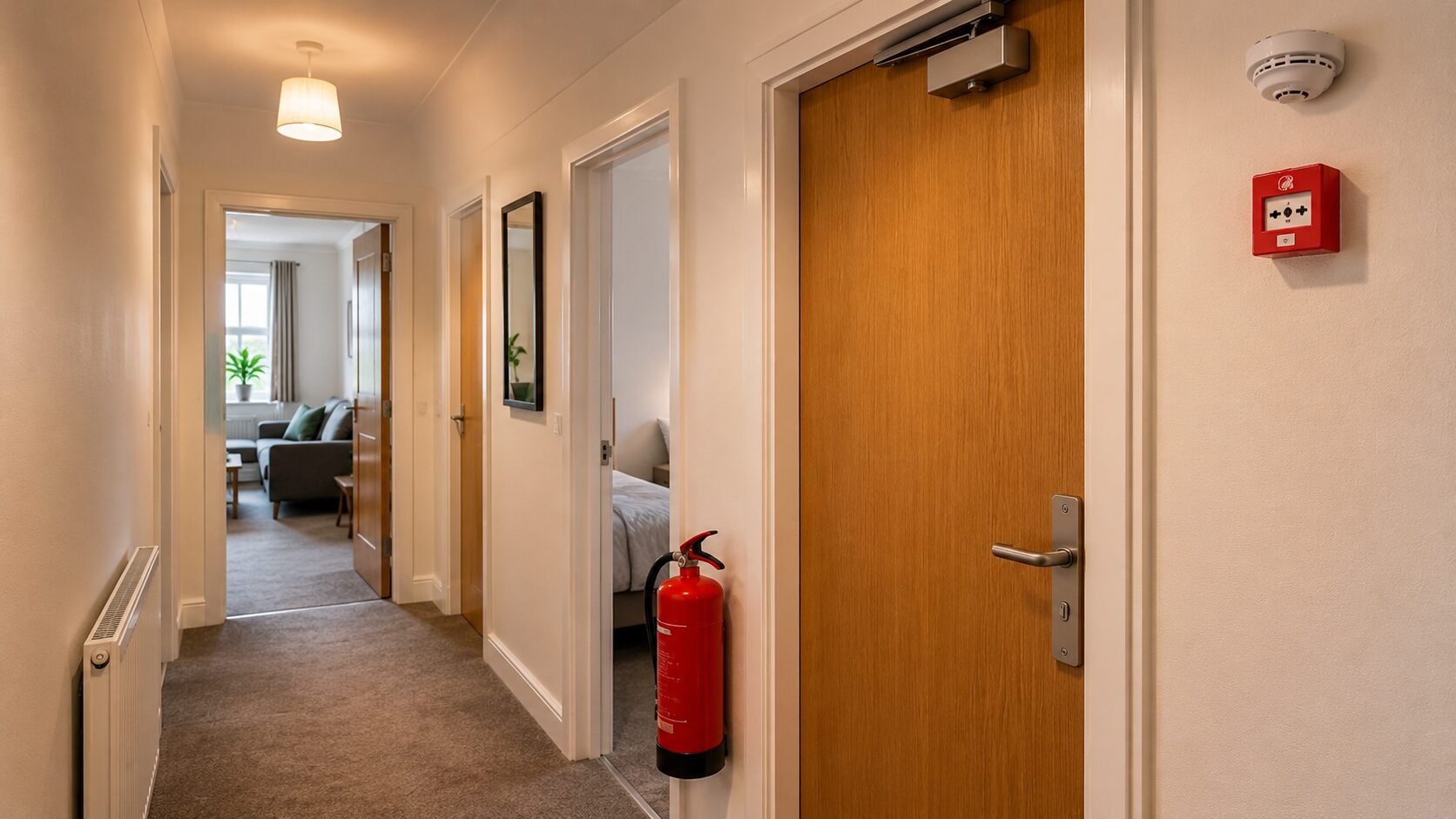
The law is often focused on the common parts and the routes people would use to get out in an emergency. That can include corridors, stairs, lobbies and other shared areas. In some buildings, entrance doors opening onto escape routes also become a key part of the strategy.
Do not assume that every rule applies in the same way inside each private room just because the building is an HMO. Some internal provisions may still matter, especially where alarms, detection, doors or linked systems form part of the wider strategy, but you need to understand why they matter in that building.
What to check before you assume your alarms, doors, and escape route are compliant
This is the part most readers are really trying to get to.
You want to know what HMO fire alarm requirements, smoke alarm regulations for HMO properties, and wider HMO fire safety requirements mean in practice for your property. The honest answer is that you should not treat alarms, doors and escape measures as separate shopping items. They work as one package.
Fire alarms and detection
In practice, most landlords looking into alarms and detection are trying to answer one thing: what system does this building actually need?
That answer depends on the layout, the risk profile, the escape strategy, and what the local authority expects for that type of HMO. In a straightforward shared house, the approach may be different from a taller building, a more complex conversion, or a scheme with more challenging escape conditions.
This is where generic advice becomes risky. Alarm categories and grades are not a safe shortcut unless they have been checked against the building itself and the local compliance route.
You should verify:
- the current fire risk assessment findings
- whether the property is already licensed, or will need to be licensed
- local HMO standards for the council area
- recent or planned building works changing the fire strategy
Fire doors and protected routes
Doors are another area where assumptions often create problems. Our guide to HMO fire door requirements can help clear up any doubts.
A fire door is not just a product choice. It sits within a wider escape strategy. The door, the frame, the self-closing device, the smoke seals, the route beyond it, and the condition on site all affect whether the measure is doing the job it is meant to do.
That is why fire door advice should not be copied from another property. One HMO may need a tighter approach because of height, layout or travel distance. Another may fail because the route itself is weak, even if the doors look fine on paper.
If you are changing layouts, adding rooms, converting loft space, or reworking circulation, check the fire implications before finalising the design. It is far easier to adjust the design early than to retrofit the wrong strategy once works are moving.
Emergency lighting, signage, and other common extras
Emergency lighting, fire signage, fire blankets, door notices, and similar items often appear on HMO fire checklists. Our guide to emergency lighting requirements in an HMO explains one of the areas that is often misunderstood. Some are standard in certain settings. Some are triggered by the building risk profile. Some are expected through local standards or management practice.
This is exactly why you should avoid blanket statements.
The right question is not “do HMOs need emergency lighting?” The better question is “does this HMO, with this escape route and this use, need emergency lighting or signage to support safe escape and compliance?”
That shift in approach usually saves time, cost and avoidable rework.
Project proof: why this matters on a real scheme
A good example is the Kilburn High Road project.
This project is relevant because it shows how fire compliance can shape the whole direction of an HMO scheme, not just the specification of a few products. The building was over 11 metres and needed careful coordination between means of escape, fire safety measures, approvals and the overall viability of the conversion.
If your own project has awkward circulation, extra height, a mixed building form, or pressure on room numbers, this is exactly the point where a joined-up review earns its keep.
Common fire regulation mistakes that cost landlords time and money
Most compliance problems are not caused by bad intent. They usually come from mixing half-right information from different sources.
Treating old blog advice as a full specification
A lot of online content talks confidently about fire regulations for HMO properties or smoke alarm regulations for HMO as though the answer is universal.
It is not. Some guidance is helpful. Some of it is out of date. Some of it applies only in a certain building type or council area. Some of it confuses management duties with technical design.
Use articles to understand the issues, not to fix the solution too early.
Mixing up licensing, fire law, and electrical rules
These are connected, but they are not the same thing.
An electrical inspection cycle is not the same as a fire alarm testing regime. A licensing condition is not the same as a Building Regulations requirement. A fire risk assessment is not a substitute for technical design where building work is planned.
When these strands get blurred, the wrong person gets asked the wrong question, and the answer can sound more settled than it really is.
When it makes sense to get a fire-led design review
There comes a point where general guidance is no longer enough.
If the building has awkward geometry, extra height, a loft conversion, a mixed-use ground floor, non-standard circulation, or uncertainty around licence expectations, it helps to review the whole picture together rather than chase single answers one by one.
Signs your HMO needs a joined-up compliance review
You should pause and get project-specific advice if:
- the property has more complexity than a straightforward shared house
- you are changing the layout or increasing room numbers
- the current fire setup feels pieced together rather than designed as a whole
- you are unsure whether the issue is licensing, Building Regulations, management, or all three
FAQs
What fire regulations apply to an HMO in England?
Most HMOs in England need to meet a mix of national fire safety duties and local authority expectations. The shared parts of the building are usually the starting point under fire safety law, but the detailed measures often depend on the fire risk assessment, the building form, and local HMO licensing standards.
Do all HMOs need the same fire alarm system?
No. That is one of the most common false assumptions. The right system depends on the building, the risk profile, the escape arrangement, and the local compliance route.
Do HMO fire regulations apply inside bedrooms as well as common parts?
The common parts are often the main legal focus, but some internal measures can still matter where they form part of the wider fire strategy. This needs to be checked in context.
When do fire doors become a bigger issue in an HMO?
They become especially important where the escape route is more sensitive, where the layout is more complex, where the building is taller, or where room and circulation changes affect how fire and smoke could spread.
Do the 2022 and 2023 fire regulation updates change every HMO?
No. The updates introduced duties that matter to many multi-occupied residential buildings, but they do not create one standard fire package for every HMO.
How often should HMO fire safety be reviewed?
It should be reviewed regularly and whenever there is reason to think the current arrangements may no longer be suitable, such as changes to layout, occupancy, condition or use. The exact review pattern should be checked against the building risk and any local expectations.
Is this a licensing issue, a Building Regulations issue, or both?
It can be both. Licensing, Building Regulations, fire safety duties and day-to-day management often overlap in HMOs, but they are not interchangeable. That is why the order of checks matters.
A final note before you act
You do not need to know every regulation from memory to make a good decision. You do need to know where the generic advice stops, what must be verified for your building, and which issue should be solved first.
That is usually enough to avoid the expensive mistakes.
For practical updates, useful resources and lessons from live HMO projects, you can also join the newsletter here.
Published by Giovanni Patania
on 06/05/2026
Giovanni is a highly accomplished architect hailing from Siena, Italy. With an impressive career spanning multiple countries, he has gained extensive experience as a Lead Architect at Foster + Partners, where he worked on a number of iconic Apple stores, including the prestigious Champs-Élysées flagship Apple store in Paris. As the co-founder and principal architect of WindsorPatania Architects, Giovanni has leveraged his extensive experience to spearhead a range of innovative projects.