

Published by Giovanni Patania
on 01/03/2026
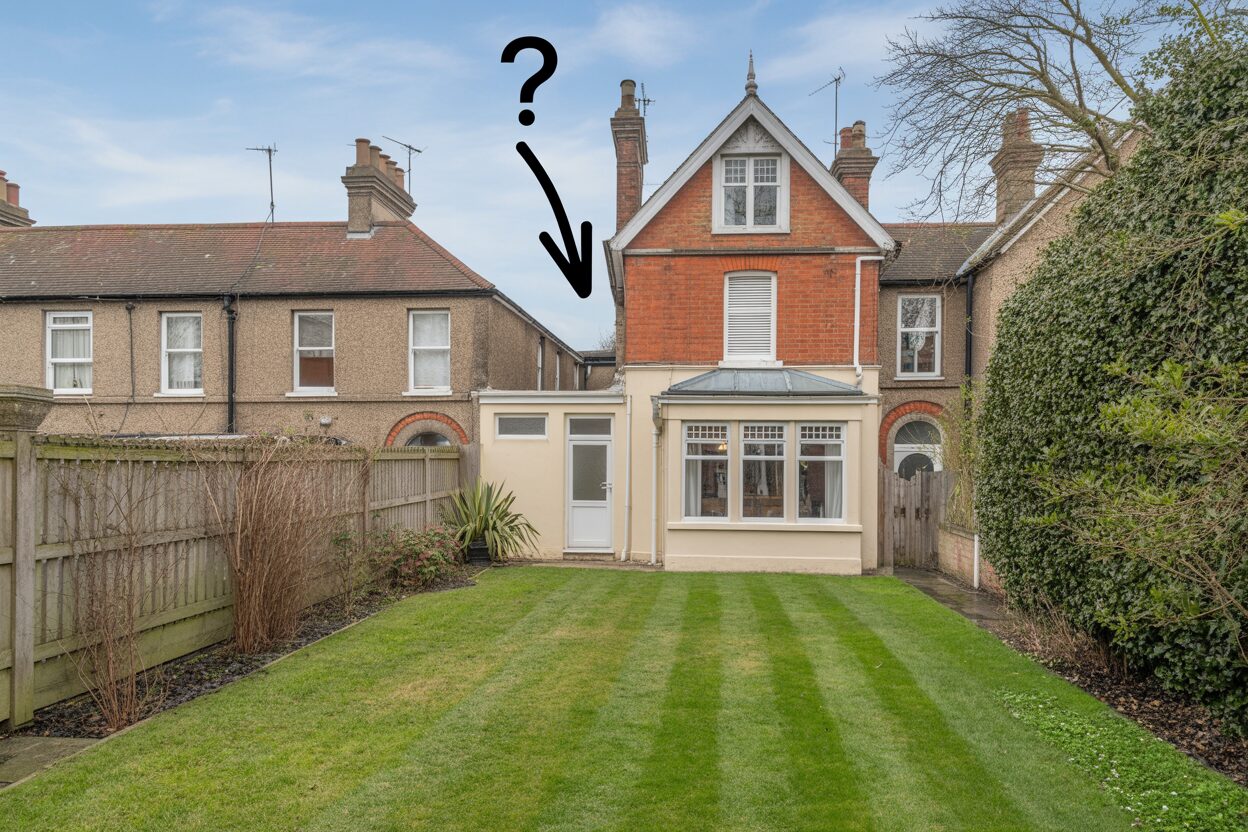
You’ve discovered an extension built without planning permission 20 years ago at your property. You need answers about where you stand legally and what to do next.
This guide explains how the 10-year rule protects you, three ways to sort out your extension, and what evidence you’ll need.
You’re almost certainly safe, but…
Here’s an important point: your extension is likely protected from action by local planning authorities.
After 20 years, your unauthorised development has almost certainly become immune from enforcement by the local planning authority. Planning rules set specific time limits after which councils can no longer take action against building works completed without permission. Understanding these protections helps you make the right decisions about sorting out your extension.
What is your legal position after 20 years?
Before we get into why, it’s important to let you know straight off. Current planning law is highly likely to protect you and your extension.
After 20 years, your unauthorised development has almost certainly become immune from enforcement. The local planning authority can probably do nothing about it.
The current rules set out specific time limits. After that, councils can’t take action against building works completed without permission. Here’s why.
The 10-year rule
The 10-year rule determines when unauthorised works become lawful for planning purposes.
The 10-year rule replaced the 4-year rule on 25 April 2024. Building operations completed more than 10 years ago are now protected. The planning authority can not challenge it or start enforcement action against you.
However, certain situations prevent this protection from applying. You should know about these circumstances:
- Listed buildings: If yours is a listed building, there’s no time limit on enforceability.
- Deliberate concealment: If you hid the development from authorities, the council can prosecute you.
- Conservation areas and Article 4 Directions: These areas are known as designated zones. There may be different rules affecting your property and development rights.
What changed in April 2024?
The Levelling-up and Regeneration Act came into force on 25 April 2024.
Before then, unauthorised developments only needed four years before becoming immune. Now, the government has pushed up the time limit to 10 years.
Transitional provisions protect developments completed before 24 April 2024 under the old rules.
WindsorPatania note: The General Permitted Development Order (GDPO) is national planning legislation. The GDPO sets out what you can build without applying for planning permission. If you built under the GDPO, the four or ten year rule is not of concern. The only time it will be is if your permitted development breached the GDPO limits or conditions. For example, you may have exceeded size, height or boundary restrictions.
Three ways you can protect yourself further
As we’ve established, you are probably safe under the recently changed law. But there are three paths open to you on how to protect yourself further.
Each route has its own advantages and requirements. Make sure the path you choose matches your situation and offers the right level of protection. The last thing you want is for this to cause problems when you come to sell or remortgage.
1. Certificate of lawfulness
A certificate confirms your development is immune from enforcement. It is a legal document that proves its lawfulness. They are sometimes referred to as Lawful Development Certificates (LDCs) or Certificates of Lawfulness for Existing Use or Development.
Liverpool City Council confirms that an LDC provides the formal confirmation homeowners want. It provides that existing development is lawful and the council can not launch an enforcement against it. You have immunity for planning purposes. It doesn’t grant permission retrospectively but it confirms your extension is now lawful.
You need to prove your extension has existed continuously for more than 10 years. The planning authority will consider the evidence you provide them. If they’re satisfied, they’ll issue an LDC.
Hang onto these documents, especially for when you’re selling the property or remortgaging. Prospective buyers and mortgage lenders will want to see this documentation.
One of the main benefits of this route is that it gives you certainty under current planning regulation. The local planning authority cannot refuse you based on what the current standards or design preferences are. Their only yardstick from judgement is time elapsed.
2. Retrospective planning permission
Retrospective planning permission is a way of winning planning approval post-construction.
Retrospective planning applications cost the same as standard planning applications. For residential extensions, that’s £528.
If you go down this route to fix a potential planning breach, you’re putting yourself at risk. That’s because the local authorities will assess your 20-year old extension against both the:
- National Planning Policy Framework
- Local planning policies
They’ll assess it on its individual merits just like any new planning application.
Councils will consider its external appearance and whether it fits with planning policies. They’ll examine potential flood risk and its impact on the surrounding area. The council will invite local community comments on your retrospective application.
Your planning authority can grant permission, refuse, or ask for changes. If they refuse your retrospective permission, enforcement action will follow.
The 87.5% approval rate for retrospective applications is comforting but it’s not certainty.
You should really only consider this route only if you don’t have the evidence for an LDC. Another reason you might want it is formal planning permission for changes to its current structure.
3. Indemnity insurance policy
Indemnity insurance gives you protection against future enforcement action or loss of value. This is a viable option if documentation of your extension is missing.
Indemnity policies cover legal costs if the local council challenges your extension. It also compensates for property value loss if the council forces you to remove it. Policies typically cost between £200 and £500 depending on property value and risk.
Mortgages lenders often want to see this if you’re trying to remortgage your property. When it passes onto a new one, they get the benefit of legal protection.
Choose this route when you want immediate protection without dealing with planning authorities.
Building Regulations: the other half of compliance
Many property owners confuse planning permission with Building Regulations approval. These are separate legal requirements serving two very different purposes.
While you’re immune from planning enforcement, you’re not immune from building regulations compliance. That could mean the structure isn’t considered safe, energy efficient or even fit for use. That means you could face real problems selling, insuring or remortgaging the property.
Why planning permission isn’t enough
Planning permission is about whether a development is right for where it is. It considers design, appearance and impact on neighbours. Building Regulations is about issues like:
- Structural safety standards
- Fire protection
- Drainage requirements
- Thermal efficiency
Your local council’s Building Control team enforces Building Regulations. They are completely independent of the planning department.
If your property is non-compliant with Building Regulations, that can:
- Stop property sales when solicitors discover missing documentation.
- Invalidate building insurance if major defects exist.
Getting retrospective Building Regulations approval
You can seek approval retrospectively for building works completed without proper certification.
Building work after 11 November 1985 can get retrospective approval through regularisation. This only applies to work carried out after this data. Submit an application to your local authority building control team showing what was built.
There are risks to this, as Leicester City Council noted.
The extension may need intrusive inspections. This could mean removing sections of plasterboard, flooring or ceiling finishes to expose wiring, pipework and so on. Inspectors may want you to uncover your foundations, drainage or structural elements. They may use trial holes to check compliance. At the end, the building control surveyor will list any remedial work if they find problems.
Once they’re happy the work meets an acceptable standard, you get a completion certificate. Be aware that regularisation costs more than original approval fees. You may also need to order additional construction work to meet the current standards.
What evidence do you need?
To get a lawful development certificate, you need quality evidence. Gather information from multiple sources covering different time periods throughout the 10-year window. If you’re a new owner, ask the previous owner or neighbours for proof.
The types of documents required include:
| Evidence Type | What It Proves | Where to Find It |
| Council tax records | Property configuration over time | Request from local authority or billing history |
| Utility bills | Ongoing property use and configuration | Energy suppliers and personal records |
| Tenancy agreements | Continuous occupation and property description | Landlord records and letting agents |
| Building insurance | Property details at specific dates | Insurance company archives |
| Photographs | Physical appearance at different times | Personal collections and neighbours |
| Statutory declarations | Witness statements about extension age | Prepared by solicitor with neighbours or contractors |
| Completion certificates | Building regulations compliance evidence | Building control department |
HMO Architects: your planning and Building Regs partner
We hope you take away from this article that, for once, non compliance is probably not going to come back and bite you. Other key takeaways are:
- Gathering the additional evidence you need to prove that your extension in more than 10 years old
- Avoiding the effective full planning application that retrospective permission involves
- Go for certificate of lawfulness before prior approval to see if the council grant you it
We’re HMO Architects, one of the UK’s fastest growing boutique architectural practices. We offer clients a start-to-finish, featuring services like:
- Investment strategy calls: Ryan Windsor was 17 when he began building his own extensive property portfolio. He’s helped over 2,200 clients across his career. Book a strategy call with Ryan and get bespoke advice on how to increase your net value and income with HMO properties.
- Feasibility study: Giovanni Patania is our Architect Director. He and his team are available to talk to you on all pre-buy and design feasibility issues related to a property purchase you have in mind. This includes factoring in compliance costs like fire safety measures and carbon monoxide alarms.
- End-to-end service: Access a range of key services under one roof for your proposed development. We provide architecture design and planning consultants to building regs and interior design. The experts you need are all in one place.
- Compliance: If you require planning permission or prior approval, we can help. We have a 97% success rate across 200 councils. We’re familiar with permitted development rights, prior approval and other planning routes.
- Wider network: Plug into our pool of trusted professionals. Access experts like property development finance brokers to arrange a competitive HMO mortgage at the best possible mortgage interest rates. Find the best accountants to help you extract the maximum tax benefits and take advantage of every tax deductible. If you want to manage your own houses in multiple occupation, get in touch with specialist letting agents who can help you with issues like tenant screening and general property self management.
Check out our detailed HMO legal FAQ and find out more about the true cost of unlicensed HMOs on our website. Discover whether HMOs, buy to lets or stocks and shares deliver the best return. When you get in touch, ask Ryan about his BRRR method and how to use it as your investment strategy.
View our range of development finance case studies to see how we’ve helped clients turn their ideas into sound investments. Read customer stories on HMO, flat, holiday let and housing projects.
Published by Giovanni Patania
on 01/03/2026
Giovanni is a highly accomplished architect hailing from Siena, Italy. With an impressive career spanning multiple countries, he has gained extensive experience as a Lead Architect at Foster + Partners, where he worked on a number of iconic Apple stores, including the prestigious Champs-Élysées flagship Apple store in Paris. As the co-founder and principal architect of WindsorPatania Architects, Giovanni has leveraged his extensive experience to spearhead a range of innovative projects.